The Coffin Ship by Cian T. McMahon;
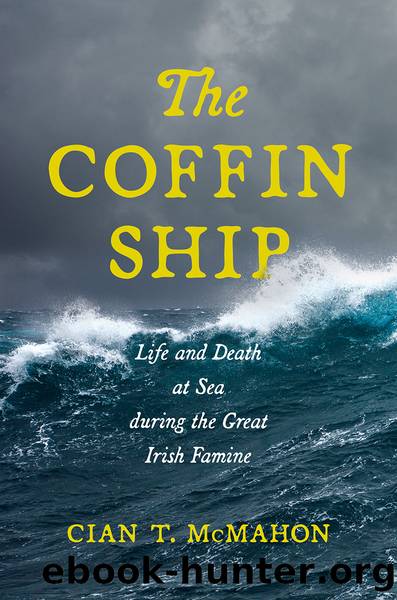
Author:Cian T. McMahon; [McMahon, Cian T.]
Language: eng
Format: epub, pdf
Tags: HIS018000 History / Europe / Ireland
Publisher: New York University Press
Altar nor Priest have we, Mary Astore!
Yet on this stormy sea, Mary Astore!
We can our vespers say,
We can for Ireland pray;
God wipe her tears away, Mary Astore!
In the context of ever-present danger, religious faith offered relief as much in the then and there as it did in the everlasting.31
While the authorities recognized that professional medical knowledge and skill could save lives at sea, those coming from rural societies were often afraid of what was in the doctorâs bag. In his report on the excess mortality of children on certain ships headed to Australia in 1852, Thomas Murdoch of the CLEC apportioned a large part of the blame to the parents themselves. âThe extent of the mortality is in part ascribed to the insurmountable objection of the Irish and Scotch parents to the medical treatment of their children,â Murdoch explained. When three-year-old John Cadogan died aboard the Australia-bound emigrant ship George Seymour in 1847, its surgeon described the childâs mother as âthe lowest caste of Irish and endeavors to conceal any ailment the child may have.â Just two days before John died, âthe mother stated the child was much better.â When deaths occurred, surgeons often preferred to conduct autopsies to confirm their suspicions regarding cause of death. The friends and families of those who died, however, being already upset by the personâs passing and the thought of their committal to the âtrackless deep,â often objected to such a procedure. When Patrick Begg, an ordinary seaman, died after a nasty fall aboard the Irish convict ship Hyderabad in 1849, the surgeon sought to dissect the body but demurred as it was blowing a heavy gale of wind at the time âand the manâs shipmates objected to there being a postmortem examination.â Similarly, âthe indomitable prejudice of the prisoners against necrotomyâ persuaded Jonathon Ferrier not to proceed with one on board the Irish female convict ship Earl Grey in 1850. Finally, some surgeons respected the sorrow caused by sudden deaths. When Irish convict Lucy Gorman died on board the Midlothian in late 1852, David Thomas admitted that from âthe general despondency produced by this unforeseen termination, I did not think it advisable to examine the body but have no doubt that it was a case of metastasis to the heart and lungs.â32
Coming from a society in which wakes and other preburial practices played important social roles, nineteenth-century Irish emigrants often attempted to follow these customs at sea. During his tenure as US consul to Bremen in 1847, Ambrose Dudley Mann explained the connection between emigrant beliefs and the transmission of disease. âIn all Catholic countries there is an extraordinary degree of devotionâproceeding from the best impulses of the human heartâto the memory of the departed; and nowhere, perhaps, does this sentiment prevail to a greater extent than in Ireland,â wrote Mann. âThe humblest peasant, so destitute as to be unable to enjoy any other visible remembrance of the lost ones dearest to him, fondly clings to the garments, however ragged and worthless, worn by them when living.
Download
This site does not store any files on its server. We only index and link to content provided by other sites. Please contact the content providers to delete copyright contents if any and email us, we'll remove relevant links or contents immediately.
The Vikings: Conquering England, France, and Ireland by Wernick Robert(84529)
Ali Pasha, Lion of Ioannina by Eugenia Russell & Eugenia Russell(40376)
The Conquerors (The Winning of America Series Book 3) by Eckert Allan W(38734)
The Vikings: Discoverers of a New World by Wernick Robert(37044)
Cecilia; Or, Memoirs of an Heiress — Volume 1 by Fanny Burney(32709)
Cecilia; Or, Memoirs of an Heiress — Volume 2 by Fanny Burney(32073)
Cecilia; Or, Memoirs of an Heiress — Volume 3 by Fanny Burney(32055)
Empire of the Sikhs by Patwant Singh(23184)
The Secret History by Donna Tartt(19438)
Hans Sturm: A Soldier's Odyssey on the Eastern Front by Gordon Williamson(18707)
Cat's cradle by Kurt Vonnegut(15526)
Pimp by Iceberg Slim(14775)
Sapiens: A Brief History of Humankind by Yuval Noah Harari(14537)
Norse Mythology by Gaiman Neil(13538)
Talking to Strangers by Malcolm Gladwell(13517)
Leonardo da Vinci by Walter Isaacson(13473)
4 3 2 1: A Novel by Paul Auster(12600)
Underground: A Human History of the Worlds Beneath Our Feet by Will Hunt(12218)
The Radium Girls by Kate Moore(12167)
